
They told you Black don't crack. Nobody mentioned what it does instead.
It isn't a myth — deeper skin genuinely does hold up longer. But it changes in a different way, and almost nothing written about menopause and skin describes it. You weren't wrong to believe it. You were just never told the rest of the sentence.

-
1
It arrives as texture, not as wrinkles.
Every article about skin after menopause is an article about lines. So that's what you watched for — and on us they arrive later and shallower.
What arrived instead was texture. Ashiness back an hour after you moisturise. A dull, grey cast on shins, knees and elbows. Skin on the backs of the hands gone thin and papery. Nobody had given you a name for any of it.
-
2
And it landed on a barrier that was already the most fragile.
Ceramides are the lipids that make up roughly half your skin's moisture barrier. Research has found deeper skin carries the lowest ceramide content of any ethnic group — alongside the highest oil production — and is the most prone to water loss because of it.1
Highest oil. Lowest barrier lipids. So when that barrier weakened further, it weakened from a starting point that was already leaking — which is why ashiness has followed you around since long before any of this began.
-
3
And the one thing that might have helped left marks instead.
Retinol is what everyone recommends. If you've ever put it on your arms or chest and then spent four months watching a dark patch fade, you already know how that ends. Stinging means inflammation, and on deeper skin inflammation is what leaves marks behind.
BLOOM uses bakuchiol instead — comparable improvement in the appearance of lines and wrinkles in a twelve-week head-to-head study against retinol, with significantly less peeling and stinging.2 In an oil base, so it seals the barrier rather than evaporating off it. No retinol, no drying alcohols, no sulfates, no parabens.
You weren't behind on your skincare.
You were watching for the wrong thing, on skin nobody was writing about.
1. Comparative ceramide content, sebum levels and transepidermal water loss in skin of colour are reported in the dermatology literature and describe skin in general, not the effect of any product. 2. Dhaliwal S, et al. Prospective, randomized, double-blind assessment of topical bakuchiol and retinol for facial photoageing. British Journal of Dermatology 2019;180(2):289–296. BLOOM is a cosmetic body oil that improves the look, feel and condition of skin. It is not a hormone treatment and does not treat menopause or any medical condition.


BLOOM Body Oil
BLOOM Body Oil
For skin that changed after menopause — and every cream that didn't help.
-
Absorbs in under a minute — no greasy film, nothing clinging to clothes
-
Made for where age shows first — neck, hands, chest, arms & legs
-
Bakuchiol — the smoothing benefits of retinol, without the peeling or stinging
-
Softer from the first night. Visible texture change over weeks, not weekends.
-
60 nights to decide. Keep the bottle either way.
FINAL SUPERSAVINGS
Couldn't load pickup availability
Why BLOOM works where lotions didn't
Why BLOOM works where lotions didn't
After menopause, your skin doesn't just lose collagen. It loses the signal that tells it to keep making more.
Your skin's structural layer depends on oestrogen to keep renewing collagen and elastin. As oestrogen falls, that instruction stops arriving — research suggests skin collagen can drop by as much as 30% in the first five years after menopause, and around 2% a year after that.
The same shift weakens the outer barrier that holds water in your skin. Which is why moisturiser stopped working on you: a water-based cream on a barrier that can't hold water is water poured into a leaky bucket. You weren't being inconsistent. You were topping up something that couldn't be held.
BLOOM does the two things that help. It's an oil, so there's nothing in it to evaporate — it stays on the surface and supports the barrier rather than soaking through it. And it's built around Bakuchiol, the plant-derived ingredient tested head-to-head against retinol over twelve weeks: comparable improvement in the appearance of lines and wrinkles, with significantly less peeling and stinging.
Which matters most on the neck, chest and arms, where skin is thinnest and least forgiving.
BLOOM is a cosmetic body oil. It improves the look, feel and condition of your skin. It is not a hormone treatment and does not treat menopause or any medical condition.
What to expect, honestly
What to expect, honestly
From the first night — skin feels softer, and nothing clings to your clothes or sheets.
Within a week — the dryness stops coming back by lunchtime. Rough patches on shins, elbows and forearms start to soften properly.
Around three weeks — the papery, crepey look on the arms and chest catches the light differently. Skin looks more hydrated and more even.
Six weeks and beyond — your neck stops being the first thing you check in the mirror.
What we won't tell you: that it firms your skin in 48 hours. Skin that has been dry for years does not change over a weekend, and anyone promising you it will is setting you up to be disappointed. That's exactly why we give you 60 nights instead of 30.
BLOOM is a cosmetic body oil. It improves the look, feel and condition of your skin — it does not produce structural or medical change. Results vary from woman to woman.
How Do I Use BLOOM For Best Results?
How Do I Use BLOOM For Best Results?
Apply to clean, dry skin morning and evening.
Start with the areas that show it first — shins, knees, elbows and the backs of the hands — then neck, chest and upper arms.
On the neck, use upward strokes from the collarbone toward the jaw. On the hands, work it into the backs and between the knuckles.
For the silkiest finish, apply straight after a shower while your skin is still slightly warm. Give it about a minute to absorb before you dress.
A little goes further than you think — two to three pumps covers the neck, chest and both hands.
Store in a cool, dry place away from direct sunlight.
Key Ingredients
Key Ingredients
Bakuchiol — plant-derived alternative to retinol. Helps skin look smoother and more refined, without the dryness, peeling or stinging.
Sweet Almond Oil — softens and deeply nourishes dry, tight-feeling skin.
Evening Primrose Oil — rich in fatty acids; helps skin look supple and well-conditioned.
Vitamin E — antioxidant that supports the skin's moisture barrier.
Geranium (Pelargonium Graveolens) Flower Oil — soothing botanical with a soft, warm scent.
Patchouli Oil — grounding base note; leaves skin feeling smooth and conditioned.
Shipping Information
Shipping Information
All orders are fulfilled and then shipped out to anywhere in 1-2 working days on average.
Worldwide shipping takes 4-12 working days depending on location:
- United States: 4-8 days
- Europe: 4-7 days
- Australia: 4-12 days
- United Kingdom: 4-7 days
- Canada: 4-9 days
- Rest of world: 5-12 days
All orders come with tracking information once shipped.
Returns
Not happy with your purchase? No worries, we've got you covered! The 60-Night Silk Test: use it every night for 60 nights. If your skin doesn't feel softer, smoother and more cared for than it does today, email info@bloomvitaglobal.com and we'll refund you. No forms, no questions, and you keep the bottle.




Water in a leaky bucket
You've probably assumed you needed something thicker. You didn't. You needed a different kind of product.
Mostly water
Most body lotions are water-based emulsions. Water does what water always does — it evaporates. That's the softness fading two hours after you applied it, and it's why you've re-applied all day and still gone ashy by evening.
No water to lose
BLOOM is an oil. There's nothing in it to evaporate. It absorbs into the surface and stays — sealing moisture in rather than sitting on top and drying off. Applied once in the morning, still soft at bedtime.
And this is where bakuchiol comes in. It's the plant-derived ingredient women reach for when retinol is too harsh — tested head-to-head against retinol over twelve weeks, with comparable improvement in the appearance of lines and wrinkles and significantly less peeling and stinging.
On our skin, that second half is the whole point. Stinging means inflammation, and inflammation is how you end up with a dark patch that takes four months to fade — which is exactly why so many of us quietly gave up on body retinol and went back to the tub of cocoa butter.
So stop buying water.
Stop buying water. Start sealing what's already there.
The 60-Night Silk Test · Free shipping on 2+ · Keep the bottle if you return it
Where it shows on us first
Not the places a wrinkle-cream advert would show you. These are the ones that go ashy, dull and papery years before anything appears on your face.

Shins & knees
The grey cast that's back before you've left the house. The first place ashiness ever announces itself.

Arms & elbows
Elbows darker and rougher than the skin around them, and the papery look that makes sleeveless a decision.

The backs of the hands
Steering wheel, coffee cup, your phone. Constantly on show, constantly washed, almost never treated.

Chest & décolleté
Thin skin, decades of sun, and the reason a V-neck quietly gets swapped for a higher collar.

The neck
The one that gives you away in daylight and in photographs. Two pumps, upward strokes, morning and night.
How to use it
Two to three pumps. Shins, knees, elbows and the backs of the hands first — then chest and décolleté, upper arms, thighs and stomach. Upward strokes on the neck. Morning and evening on clean skin, and best of all straight out of the shower while your skin is still warm.

THE SKIN YOUR ROUTINE FORGOT.
Made for the places that show it first:
✦ The neck that gives you away in daylight
✦ The backs of the hands on the steering wheel
✦ The chest that made you swap the V-neck for a higher collar
✦ The upper arms that made sleeveless feel off the table
✦ The shins and knees that look dry under bright light
✦ Skin that's been quietly doing this alone for years
What the first 60 nights actually look like
We'd rather tell you the truth than promise you a weekend miracle. Here's the honest sequence, in the order women report it.
It sinks in — and stays in
The first thing you'll notice is what doesn't happen: no greasy film, no shine, nothing clinging to your clothes or your sheets. Skin feels softer within a minute of massaging it in.
The dryness stops coming back
This is the one women mention most. Instead of soft at 9am and tight again by lunch, skin stays comfortable through the day. Rough patches on shins, elbows and forearms start to soften properly.
Texture starts to look different in daylight
The papery, crepey look on the arms and chest catches the light differently. Skin looks more hydrated and more even — the difference shows in photographs before it shows in the mirror.
Your neck stops being the first thing you check
The point of all this. Not that it's suddenly twenty years younger — that the area you'd been quietly monitoring every morning stops demanding your attention, and you go back to getting dressed without the inspection.
Results vary from woman to woman. These stages reflect what customers commonly report; they are not a guarantee of identical outcomes. BLOOM is a cosmetic body oil that improves the look, feel and condition of skin — it does not treat medical conditions or produce structural change. Visible differences depend on consistency, skin condition, sun exposure and overall health.
What 1,000+ women told us — including the ones who weren't sure at first
from 1,056 reviews
Why it works?

THE SIGNAL STOPPED, NOT YOUR SKIN
Your skin's structural layer relies on estrogen to keep renewing collagen and elastin. As estrogen falls, that instruction stops arriving — and no cream you tried was ever addressing that.

NOTHING IN IT TO EVAPORATE
Body lotion is mostly water, and water evaporates — that's the softness gone by lunch. An oil has nothing to lose, so it stays on the skin and keeps working through the day.

BUILT FOR BELOW THE JAWLINE
Neck, hands, chest, arms, thighs and legs — roughly 90% of the skin people actually see, and the part almost every skincare routine ever built leaves out entirely.

SIXTY SECONDS, THEN GET DRESSED
Absorbs fast enough that you can apply it and dress straight after. No shine, no sticky layer, nothing clinging to clothes or sheets.
You've already tried the jar in the bathroom cupboard
Most of us have used the same few things since we were children. Here's the honest difference — and where they still earn their place.
| BLOOM Silk Oil | Cocoa butter | Shea butter | Retinol body cream | |
|---|---|---|---|---|
| Still working at 6pm | ✓ | ~ | ~ | ~ |
| Absorbs in under a minute | ✓ | ✕ | ✕ | ✓ |
| Won't cling to clothes or sheets | ✓ | ✕ | ✕ | ✓ |
| No stinging — and no marks after | ✓ | ✓ | ✓ | ✕ |
| Safe to use daily on the neck | ✓ | ~ | ~ | ✕ |
| Targets crepey, papery texture | ✓ | ✕ | ✕ | ✓ |
| Works on the collagen side, not just moisture | ✓ | ✕ | ✕ | ✓ |
← swipe to compare →
None of this means throw the cocoa butter out. Cocoa butter and shea are genuinely good at what they do — they sit on top and hold moisture in, and there's a reason they've been in our houses for generations. What they don't do is touch the collagen side, which is what changed after menopause and what's behind the thinning and the texture rather than the dryness. Plenty of women use both: butter first, BLOOM on top to seal it in.
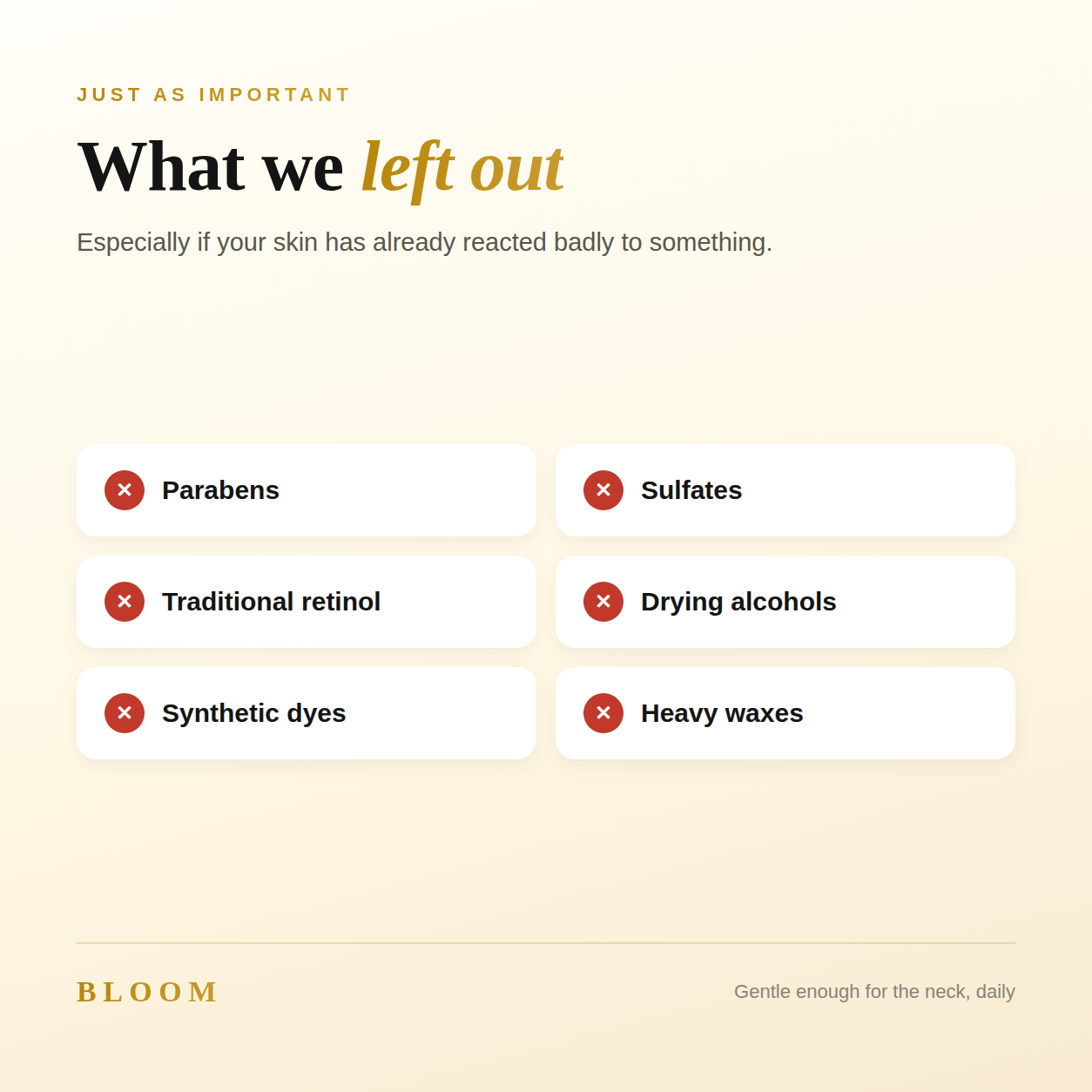
What we left out
Just as important as what's in it — especially on skin that has already reacted badly to something.
Why Bakuchiol instead of retinol
If you've tried a retinol body cream, you probably know how that ended: dryness, flaking, and a patch of skin that felt angry for a week. Bakuchiol is the plant-derived alternative women switch to for the smoothing and refining benefits without that reaction — which matters enormously on the neck and chest, where skin is thinnest and least forgiving.
You've already tried the other four.
This is the one built for below the jawline.
The 60-Night Silk Test · Free shipping on 2+ · Keep the bottle if you return it
Three things women ask before they buy
"I've tried everything since menopause. Why would this be different?"
Because most of what you tried was aimed at the symptom. Dryness and crepey texture after menopause come from a barrier that can no longer hold moisture — so adding more water was never going to hold. BLOOM is an oil, so there's nothing in it to evaporate, and it's built around Bakuchiol, which was tested directly against retinol over twelve weeks and matched it on the look of lines and wrinkles, with far less irritation.
"Won't it ruin my clothes and my sheets?"
This is the one we hear most, and it's a fair worry — most body oils absolutely do that. BLOOM absorbs in under a minute; most women apply it and dress straight after. If it doesn't behave the way we've described on your skin, that is exactly what the 60 nights are for — send it back and we'll refund you.
"I'm 62. Isn't it too late for me?"
No — and this part genuinely isn't about age. Whether skin looks hydrated, smooth and cared for comes down to whether it's actually being cared for at all, and that responds at any age. Most of the women writing to us are between 48 and 70. The ones who see the most change are usually the ones who'd never used anything below the neck before.
Sixty nights. Nothing to lose but the ashiness.
Use it every night for 60 nights. If your skin doesn't feel softer, smoother and more cared for than it does today — email us and we'll refund you. No forms, no questions, and you keep the bottle.
Sixty nights, because skin that's been going ashy for years doesn't change over a weekend, and any brand promising you it will is setting you up to be disappointed. We'd rather you find out on our money than never try at all.
Worst case, you get your money back and keep the bottle.
That's the whole risk. Sixty nights to find out either way.
The 60-Night Silk Test · Free shipping on 2+ · Keep the bottle if you return it
Women who stopped reaching for the cocoa butter at 4pm
The neck, the hands, the chest, the arms — where BLOOM actually gets used.


Before you decide
Does this actually apply to Black skin? I've always been told we age slower.
You do, in some ways — deeper skin holds up longer against lines, and that part is real. But collagen loss after menopause isn't a pigment question, it's a hormone question, and it happens to everyone.
It just shows up on you as texture, ashiness and thinning rather than wrinkles first. Which is exactly why it catches so many women off guard — you're watching for lines, and the change is happening somewhere else entirely.
I've had actives leave dark marks before. Is this going to do that?
That's the right question, and it's the reason the formula uses bakuchiol rather than retinol. In the twelve-week head-to-head study, bakuchiol delivered comparable improvement in the appearance of lines and wrinkles with significantly less peeling and stinging — and stinging is the signal that matters, because inflammation is what leads to marks on deeper skin.
That said: bakuchiol hasn't been studied specifically in Black skin, and we won't pretend otherwise. Patch test on your inner arm for three nights first. And if anything stings, stop — that rule applies to us as much as to anything else on your shelf.
Is it scented? I react to fragrance.
BLOOM contains geranium flower oil and patchouli oil, so yes — it has a natural botanical scent, and no, it is not fragrance-free.
If you know you react to fragranced products, patch test before you commit — or use the 60 nights, where you get your money back and keep the bottle either way.
I've used cocoa butter and shea my whole life. How is this different?
Cocoa butter and shea are good at what they do — they sit on top and hold moisture in. If they were enough on their own, you'd know by now.
What they don't do is address the collagen side, which is what changed after menopause and what's behind the thinning and the texture rather than the dryness. BLOOM is doing a different job. Plenty of women use both — butter first, BLOOM on top to seal it in.
FAQ
How long will it take to see results?
How long will it take to see results?
Softer, more comfortable skin from the first few uses — most women notice that the same night. The texture change on crepey-looking areas takes longer: expect around three weeks before it's visible in daylight, and six weeks or so before it's the kind of difference you stop having to look for.
We used to say 48 hours. We stopped, because it wasn't fair to you. Skin that's been dry for years doesn't change over a weekend — which is why you get 60 nights to decide instead of 30.
Will it help with crepey-looking skin?
Will it help with crepey-looking skin?
That's exactly what it's made for — the thin, papery look that shows on the upper arms, neck, chest and knees. BLOOM helps that skin look more hydrated, smoother and more even.
To be straight with you: it's a cosmetic body oil, not a medical treatment. It improves how the skin looks, feels and is conditioned. It doesn't change the underlying structure, and neither does anything else you can buy in a bottle.
Can I use it on my neck and face?
Can I use it on my neck and face?
Neck and décolleté — yes, absolutely, and it's where women use it most. Use upward strokes from the collarbone toward the jaw.
For the face itself: many women use a drop or two at night and love it. But facial skin is more reactive than body skin, so patch-test on your jawline first and start small.
BLOOM was built for everything below the jaw. That's the job it does best — and the job nothing else in your bathroom is doing at all.
I've tried firming creams before and none of them worked.
I've tried firming creams before and none of them worked.
Most of them were water-based, and water evaporates. That's why the softness was gone by lunch and you were back where you started by evening — and it means the problem was the format, not your consistency.
An oil has nothing in it to evaporate. It absorbs into the surface and stays there, sealing moisture in rather than drying off. That's the whole difference, and it's why women who'd written off this entire category tell us this one behaved differently.
Is it greasy or sticky?
Is it greasy or sticky?
No. BLOOM has a silky oil texture that glides over the skin and helps seal in softness without leaving a heavy, sticky residue.
It’s made to leave your skin feeling smooth, polished, and moisturised — not oily or uncomfortable under clothes.
Can I use it if my skin is sensitive?
Can I use it if my skin is sensitive?
BLOOM uses Bakuchiol, a gentle retinol alternative, so it gives you the firming and smoothing skincare feel without the dryness or irritation often associated with traditional retinol.
As with any body-care product, we recommend patch testing first if your skin is very sensitive.
Where should I apply it?
Where should I apply it?
Apply BLOOM anywhere your skin feels dry, rough, crepey, or less firm.
It’s especially ideal for:
Arms
Thighs
Legs
Hips
Tummy
Décolleté
Massage it in using upward circular motions until absorbed.
How do I use it for best results?
How do I use it for best results?
Apply BLOOM to clean, dry skin in the morning and evening.
For an extra-silky finish, apply after showering while your skin is still slightly warm. Let it absorb before dressing.
Consistent use is key for skin that looks smoother, firmer, and more cared for.
Is BLOOM only for mature skin?
Is BLOOM only for mature skin?
No. BLOOM is perfect for anyone who wants softer, smoother, more radiant body skin.
It’s especially helpful if your skin is starting to look dry, dull, crepey, or less toned, but you don’t need to wait until these concerns are advanced to use it.
Can I use it with my regular body lotion?
Can I use it with my regular body lotion?
Yes. You can use BLOOM on its own or layer it over your body lotion to help seal in moisture.
For the smoothest feel, apply lotion first, then BLOOM as the final step to lock in softness and glow.
Does it smell strong?
Does it smell strong?
It has a soft, warm botanical scent from geranium and patchouli — it isn't fragrance-free, and we'd rather say so plainly. Most women find it settles within a few minutes. If you know you react to fragranced products, patch test first, or use the 60 nights and send it back if it doesn't suit you.
Can I use it during pregnancy or while breastfeeding?
Can I use it during pregnancy or while breastfeeding?
If you are pregnant, breastfeeding, or under medical care, we recommend checking with your doctor before adding any new skincare or body-care product to your routine.
Are there any side effects?
Are there any side effects?
BLOOM is made to be a gentle body oil, but everyone’s skin is different.
Some women should know:
No traditional retinol harshness
No heavy greasy layer
No sticky finish under clothes
No drying feel
Made for dry, crepey-looking body skin
Patch test recommended for very sensitive skin
Discontinue use if irritation occurs.
If your skin is very sensitive or reacts easily, patch-test on a small area first and stop using it if any irritation appears.
Commitment to excellence
Each item is carefully curated — Shop now
Commitment to excellence
Each item is carefully curated — Shop now
Commitment to excellence
Each item is carefully curated — Shop now
Commitment to excellence
Each item is carefully curated — Shop now
Commitment to excellence
Each item is carefully curated — Shop now
Commitment to excellence
Each item is carefully curated — Shop now
Commitment to excellence
Each item is carefully curated — Shop now
Commitment to excellence
Each item is carefully curated — Shop now
Commitment to excellence
Each item is carefully curated — Shop now
Commitment to excellence
Each item is carefully curated — Shop now
Commitment to excellence
Each item is carefully curated — Shop now
Commitment to excellence
Each item is carefully curated — Shop now
Commitment to excellence
Each item is carefully curated — Shop now
Commitment to excellence
Each item is carefully curated — Shop now
Commitment to excellence
Each item is carefully curated — Shop now
Commitment to excellence
Each item is carefully curated — Shop now
Customer reviews
-

★★★★★
I wasn’t expecting much because I’ve tried so many body oils before, but this one feels different. My skin looks smoother, especially on my arms and thighs, and it gives such a pretty glow without feeling greasy. The scent is also so soft and expensive.
-

★★★★★
BLOOM has become my after-shower ritual. I use it while my skin is still warm and it leaves everything feeling silky for hours. My legs honestly look more polished and hydrated, like I actually take care of them every day.
-

★★★★★
I used to avoid sleeveless tops because I just didn’t like how my arms looked anymore. Since adding BLOOM to my routine, they feel incredibly soft and look much more cared for. I’ve actually started reaching for some of my sleeveless clothes again.
-

★★★★★
By the end of the day my skin used to feel tight and uncomfortable, especially after showering. BLOOM has become the step I actually look forward to. It sinks in beautifully, doesn’t leave me feeling greasy, and my skin stays soft for hours. Even my elbows and knees feel noticeably nicer.
-

★★★★★
Okay this smells amazing 😍 Not too strong, just warm and spa-like. I use it on my legs before bed and they feel so soft in the morning. It also gives a really pretty glow when I wear dresses.
-

★★★★★
I hate greasy oils, so I was nervous, but BLOOM actually sinks in. My skin feels smooth instead of sticky, and my clothes don’t cling after I put it on. That alone makes it worth it for me.


